I’ve been asked many, many times why I didn’t just bake AI into OpenToClose.com.
The answer is that AI was never really the problem I was trying to solve.
OpenToClose.com was not missing AI.
For years, Open To Close became more powerful.
More triggers.
More automations.
More conditions.
More integrations.
More configuration.
More customization.
More ways to accommodate increasingly specific workflows for increasingly specific businesses.
For a long time, that felt like progress.
Customers asked for more, so I built more.
Then they asked for more again, so I built more again.
And to be fair, a lot of what we built made Open To Close incredibly capable.
But eventually I had to confront something that I think happens to a lot of software companies:
More became the problem.
There is a chapter in Basecamp’s Getting Real called Build Less that I keep coming back to.
The premise is simple: better software does not necessarily come from adding more features, more options, and more ways to configure everything. Sometimes building a better product means having the discipline to do less.
That idea hits differently after you have spent years doing the opposite.
Open To Close had reached the limits of a software model that had become increasingly complex to build, support, learn, configure, and scale.
And that complexity affected both sides of the relationship.
It affected my company because every additional feature brought more code to maintain, more scenarios to test, more documentation to write, more support to provide, and more possible ways for things to interact.
But it affected our customers too.
More configuration meant more decisions.
More options meant more setup.
More flexibility meant more things to learn before someone could actually begin receiving value from the software.
At some point, flexibility stops feeling empowering and starts feeling like work.
That was the problem I needed to solve, not only for my company, but for my customers.
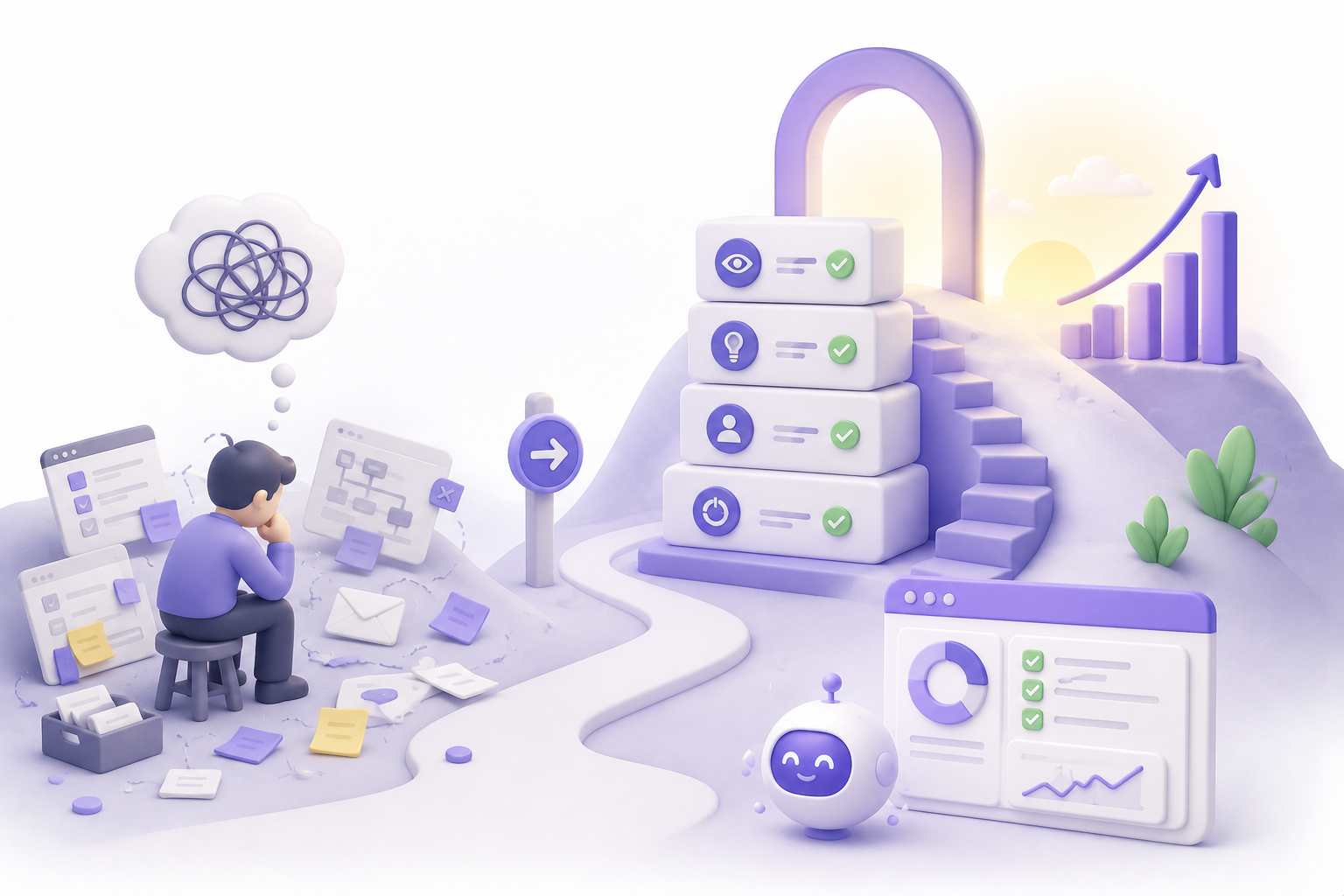
Because software should become easier to use as it becomes more capable, not require the customer to understand more and more of the machinery underneath it.
And simply adding AI on top of OpenToClose.com would not have solved that problem.
It would have been one more thing.
One more layer.
One more system interacting with everything that was already there.
More.
So I made a different decision.
Instead of asking how I could add AI to OpenToClose.com, I started asking a much more important question:
What could I remove if AI could handle the complexity instead?
That question changed everything.
I did not want to build an AI-powered version of the same increasingly complicated software model.
I wanted to rethink where the complexity should live in the first place.
So instead of bolting AI onto the old architecture, I made the much harder decision.
I built a new one.
Complexity Has a Cost
Every feature has a cost.
Not just the original cost of writing the code.
It has to be tested.
Supported.
Documented.
Explained.
Maintained.
Updated.
Made compatible with everything else.
Every trigger creates more possible states.
Every condition creates more exceptions.
Every configuration option creates another path through the application.
Every integration creates another external dependency.
Eventually, you are not maintaining features.
You are maintaining an ecosystem of interconnected complexity.
And here is the part most customers never see:
There is not an army of developers behind Open To Close.
There never has been.
A significant amount of this platform has been architected and built by me.
At some point I had to ask a very simple question:
Is this sustainable?
The answer is no.
The Economics Do Not Lie
Open To Close is infrastructure for businesses generating significant revenue.
But the amount many customers pay us represents a fraction of 1% of the revenue their operation generates.
So I considered the other option.
Charge substantially more.
Take a transaction coordination company completing 40 transactions per month at $450 per transaction.
That is:
$18,000 per month.
$216,000 per year.
If Open To Close charged 3% of that revenue, the software would cost:
$540 per month.
At 5%:
$900 per month.
That is between:
$13.50 and $22.50 per transaction.
Now the conversation changes.
A large portion of this market would immediately tell me the software is too expensive and would tell me where to go. Trust me, I’ve had those conversations many times.
Yet businesses routinely accept roughly 3% in payment-processing fees simply to move money.
I am not arguing that Open To Close should receive 3% or 5% of anyone’s revenue.
I am making a much simpler point:
Software economics are real.
You cannot indefinitely demand enterprise-level functionality, customization, automation, support, integrations, reliability, and development while expecting the infrastructure underneath your business to cost almost nothing.
Something has to give.
I had two choices:
Charge dramatically more for the complexity.
Or:
Remove the complexity.
I chose the second.
If the market will not pay for the cost of complexity, the answer is not to pretend complexity is free. The answer is to remove it.
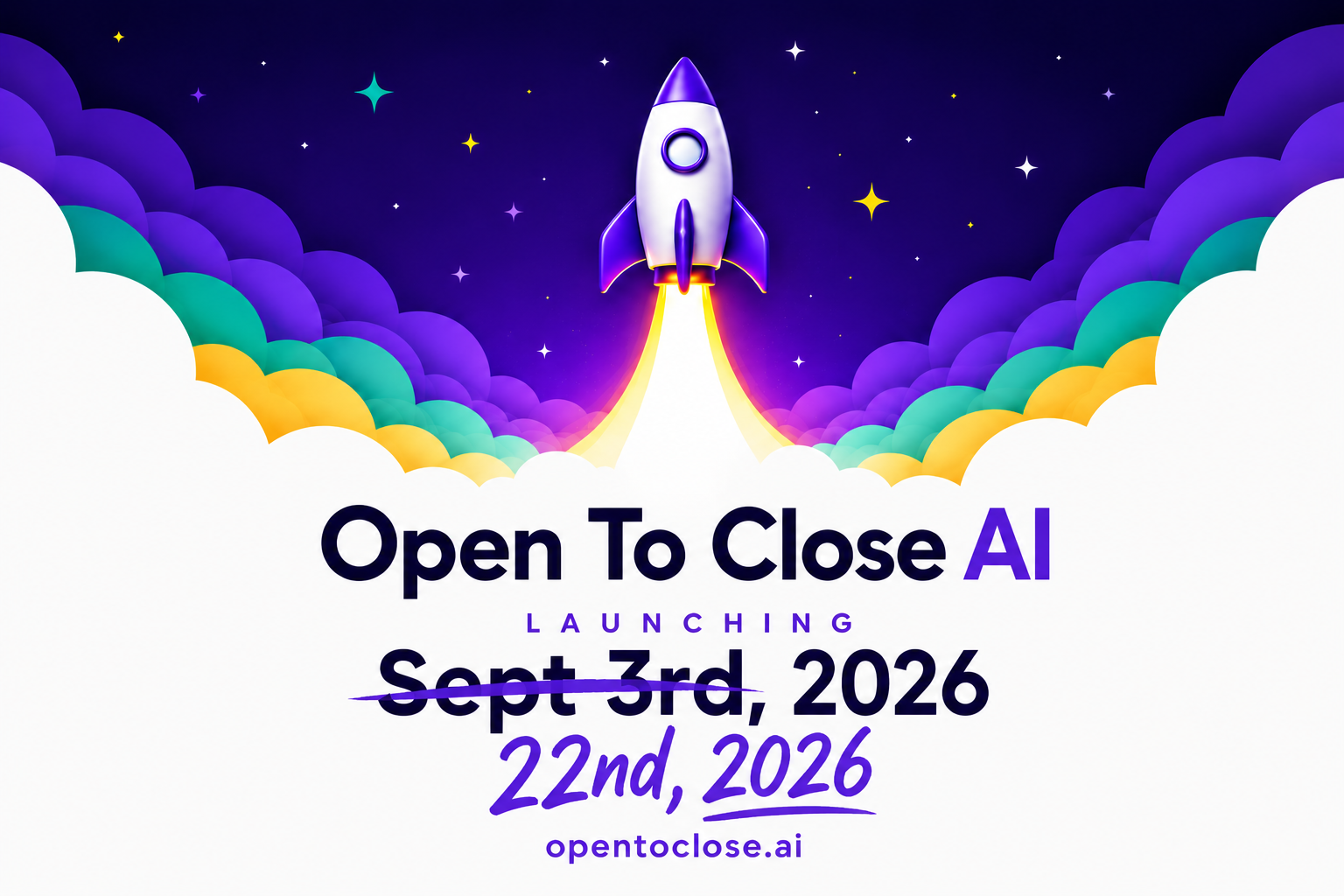
That decision became Open To Close AI.
I Did Not Build AI Because AI Is Fun
I did not spend 10k hours ( yes, it took that much time ) this last two years to build Open To Close AI because AI became fashionable.
I built it because the world changed.
AI is fundamentally changing the economics of software and the way businesses operate.
For me, this was not optional innovation.
It was a business necessity.
And if you own a business, I believe you should be asking yourself the same question I had to ask:
If I built my company from scratch today, knowing what AI can do, would I build it the same way?
If the answer is no, you have work to do.
AI should not simply write emails for you.
It should increasingly touch your operations, SOPs, customer service, sales, onboarding, reporting, forecasting, data, quality control, employee workflows, and decision-making.
Your company should increasingly be able to answer questions about itself.
What will revenue look like next quarter?
Why did churn increase?
What is revenue per employee?
Where are customers getting stuck?
Where is work being repeated?
What changed this week?
What requires attention?
I am working toward a very simple standard:
I should be able to ask my company a question and get an evidence-based answer.
That is where this is going.
The OTC Method
AI also gave me the ability to inspect everything inside my own company through what I call the OTC Method:
Visibility → Clarity → Accountability → Repeatability → Scale
Is the work visible?
Is what I am seeing clear?
Is somebody accountable for the outcome?
Can the result be repeated without heroic effort?
Can it scale without me becoming the bottleneck?
That fourth question exposed one of the biggest problems.
Repeatability.
My internal customer-acquisition data showed an average journey of approximately 278 days from initial engagement to becoming a customer.
Two hundred and seventy-eight days.
That is not just a sales statistic.
That is a watermark of complexity.
OpenToClose.com became so configurable that understanding how to configure the software became part of buying the software.
That creates friction everywhere.
Sales.
Onboarding.
Education.
Implementation.
Support.
I cannot scale that model.
With Open To Close AI, my objective is fundamentally different:
Move customers from months to less than 7 days.
Reduce the amount of configuration required before they receive value.
Reduce the amount of human intervention required to operate the system.
Move the complexity away from the customer.
That is repeatability.
And repeatability is what creates scale.
The Founder Cannot Be the Operating System
I see the same problem constantly in small businesses (TC Businesses especially).
The founder is the decision-maker.
The integrator.
The escalation point.
The accountability layer.
The quality-control system.
The keeper of institutional knowledge.
The person who knows where everything is and what everything means.
Then the founder says:
“I want to scale.”
Scale what?
If every additional customer creates another decision you personally have to make, you are not scaling a company.
You are scaling your workload.
Eventually, you run out of hours.
If you want better margins and real scale, you have to systemize the business.
That means making the work visible, clear, accountable, repeatable, and scalable.
AI gives small businesses an entirely new toolkit for doing exactly that.
You Cannot Combine Two Complex Systems and Call the Result Simple
This is probably the most important thing I can explain about Open To Close AI.
OpenToClose.com is complex.
Open To Close AI is also complex.
But the complexity exists in fundamentally different places.
OpenToClose.com says:
Expose the complexity so the user can configure it.
Open To Close AI says:
Absorb the complexity so the user does not have to.
OpenToClose.com externalizes complexity.
Open To Close AI internalizes more of that complexity into AI models, agents, orchestration, and data processing.
You can technically combine those two systems.
But you cannot combine all of their complexity and still honestly call the result simple.
If I recreate every trigger, condition, setting, workflow, and configuration option inside Open To Close AI, I do not get the best of both worlds.
I get:
Human-configured complexity.
Plus:
Agentic complexity.
Plus:
The complexity created when those two systems collide.
That is exactly what I am trying to avoid.
The goal is not to make the software less sophisticated.
The goal is to relocate that sophistication away from the customer.
That is why every feature from OpenToClose.com will not automatically appear in Open To Close AI.
Some of that complexity needs to disappear.
That is the point.
Migration Is Infrastructure, Not a Button
I also understand the frustration around migration.
Open To Close AI just launched, and understandably, one of the first questions has been: why can’t I simply move everything from OpenToClose.com into it?
Because migration between two fundamentally different architectures is not a button.
It is infrastructure.
Data has to be mapped.
Transformed.
Validated.
Tested.
Relationships have to be preserved.
Exceptions have to be handled.
And I have to determine what belongs in the new architecture and what should remain behind.
I am not going to haphazardly move years of customer data between two systems simply so I can say a migration tool exists.
A bad migration system is worse than no migration system.
Give me some time to build the bridge correctly, we launched 5 minutes ago 🙂
I Am Not Building Faster Horses
There is a quote commonly attributed to Henry Ford about customers asking for a faster horse.
Whether he actually said it is beside the point.
The lesson matters.
People naturally imagine the future using the systems they already understand.
Give me another trigger.
Another condition.
Another workflow.
Another automation.
Another setting.
A faster horse.
I am not building faster horses anymore.
Traditional software waits for a human to tell it exactly what to do.
AI-native software increasingly has the ability to read information, understand context, identify changes, interact with systems, surface exceptions, and help determine what needs to happen next.
That changes the architecture.
And if you are not familiar with AI agents and agentic processing, go study them.
You owe that to yourself if you own a business.
The next five years should not look like the last five.
I Had to Do This Myself
I am not writing this from the sidelines.
I had to tear my own company down to the floorboards.
I had to question the software.
The economics.
The workflows.
The team.
The systems.
The assumptions.
The way information moves.
The way decisions get made.
I had to look at things I spent years building and ask whether I would build them again today.
Sometimes the answer was no.
That is uncomfortable.
But my job is not to protect every decision I made five years ago.
My job is to determine what this company needs to become five years from now.
I made the decision.
I chose the architecture.
I chose to stop compounding complexity.
I chose to build around AI.
And I am accountable for where that decision takes this company.
An Olive Branch
If you own a business and all of this makes sense but you genuinely do not know where to begin, schedule a call with me.
I am happy to talk through your business.
Your operations.
Your workflows.
Your SOPs.
Your data.
Your staffing.
Your systems.
Your bottlenecks.
And where AI might fundamentally change how that company operates over the next five years.
I have had conversations with business owners where you can see the realization happen in real time: “I didn’t even know that was possible.”
I am happy to have that conversation.
You do not need to understand all of this before we talk.
You just need to be willing to question how your company works today.
The Path Forward Is Clear
Open To Close proved how powerful configurable transaction management software can become.
I built that.
I know what it can do.
And I know what it costs to maintain that level of complexity.
Now I am building around a different question:
How much of that configuration can intelligent software make unnecessary?
That is Open To Close AI.
I did not make this decision because AI was trendy.
I made it because the economics changed.
The technology changed.
The market changed.
And the old model was no longer the model I believed could carry this company through the next decade.
The old model created more capability by adding more complexity.
The new model has to create more capability while removing complexity.
The path forward is clear.
Onward we go.